One Leak vs. a Failing System
Not every leak means your roof is done. An isolated leak from a single cracked pipe boot or a lifted piece of step flashing on a roof under 15 years old is a textbook repair — a few hundred dollars and you're back to dry.
The trouble starts when leaks become a pattern. When you're calling a roofer twice a year for leaks in different spots, the problem isn't a single failure point. The shingles are losing their granules, the seal strips are lifting, and water is simply finding the next weakest path. At that stage, each repair is buying weeks, not years.
The 7 Field Indicators We Look For
During a professional inspection, we evaluate the roof as a complete system. These are the seven indicators that, especially in combination, tell us a roof is approaching end of life:
- Age over 18 years — most 3-tab shingle roofs in Western Washington reach end of life between 15 and 18 years; architectural shingles between 22 and 28.
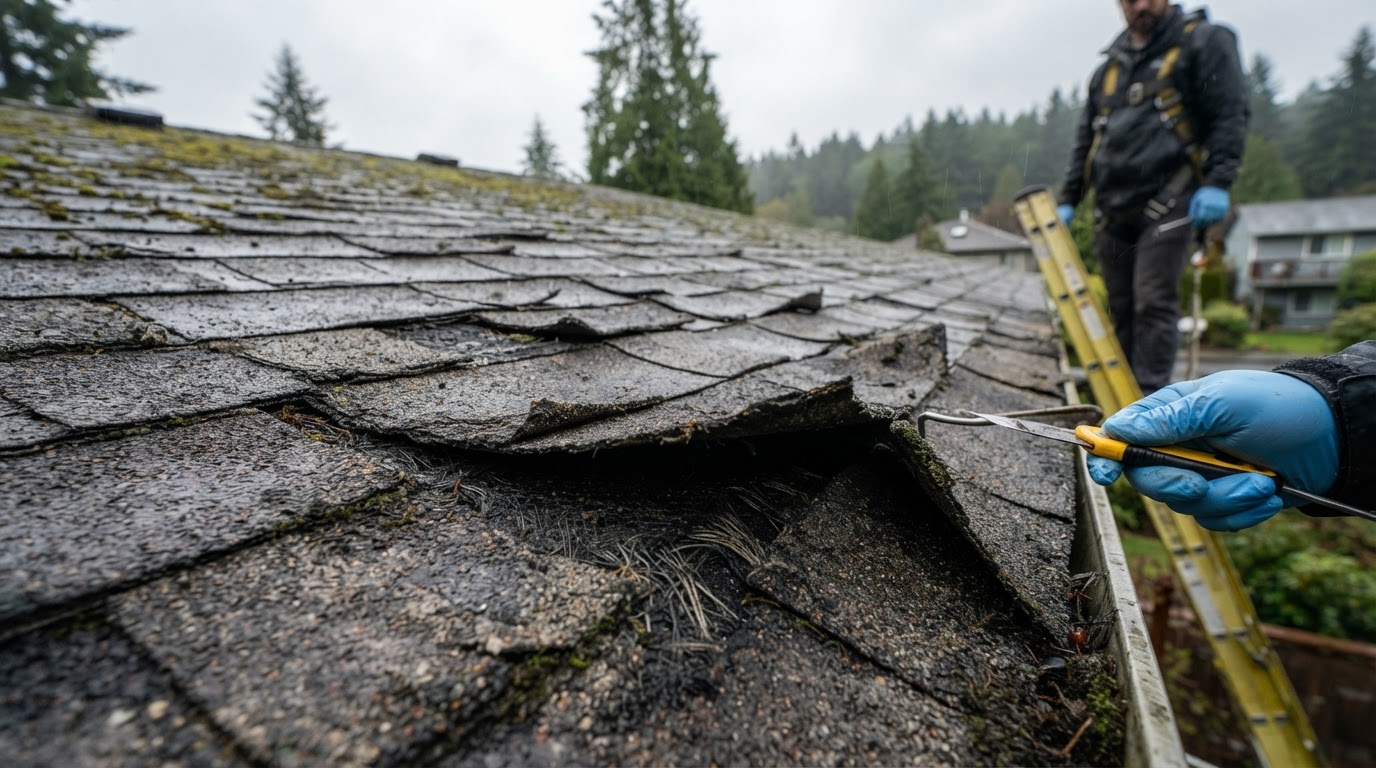
- Curling or clawing shingle edges — the asphalt is drying out, losing flexibility, and the adhesive seal strip is letting go.
- Granule wash in gutters and downspout exits — the protective ceramic coating is shedding, exposing the asphalt to UV and water.
- Soft or bouncy deck underfoot — the plywood sheathing is delaminating from sustained moisture, often from poor attic ventilation.
- Recurring leaks in different locations — a sign the system is failing broadly, not at one isolated point.
- Daylight visible through the deck boards from inside the attic — gaps, cracks, or missing shingles that compromise the weather barrier.
- Persistent moss or dark algae returning within months of cleaning — the shingle surface has roughened enough to hold spores permanently.
Why Combination Matters More Than Any Single Sign
Any one of these signs alone may justify a repair. A 12-year-old roof with one cracked pipe boot needs a new boot, not a new roof.
But when three or more indicators appear together on a roof over 18 years old, the system is failing as a whole. The granules that protect the asphalt are gone, the seal strips that hold shingles flat in wind are lifting, and the deck beneath may be softening. Patching one leak simply moves the next failure to a different spot.
The Honest Math: Repair vs. Replace
We give homeowners honest, written estimates for both options so they can compare. Here's the framework we use:
If the roof is under 15 years old and the leak is isolated, a targeted repair is almost always the right call. If the roof is over 18 years old with recurring leaks, repeated repairs plus the interior damage from leaks you didn't catch in time usually exceed the cost of a full replacement within a 3 to 5 year window.
A replacement with modern synthetic underlayment and balanced ridge ventilation also resets the clock — giving you 22 to 28 dependable years instead of chasing a failing system one patch at a time.